A Stream's Discharge Is Dependent on Which of the Following
The ability to carry large particle sizes is dependent on the streams discharge. Stream Discharge is proportional to stream stage or as Stream Stage increases so does Stream Discharge.
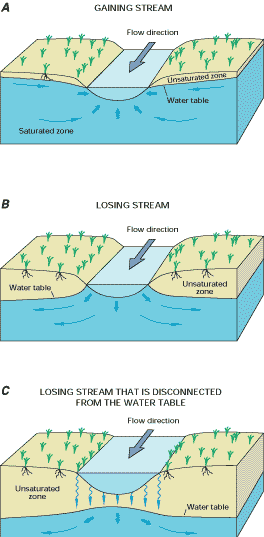
Effects Of Gw Development On Gw Flow To And From Surface Water Bodies
Stream discharge is the volume of water that passes through a cross sectional area of a stream.
. On the way from the source to the mouth. The water in a stream flowing at bankfull discharge level is usually coming from. In this regard what is used to calculate a streams discharge.
Speed of runoff volume of runoff peak stormflow. Stream has cross section. Because stream discharge cannot be measured directly it must be computed from variables that can be measured directly such as stream depth stream width and streamflow.
In the hydrologic cycle outside bank of the meander. The maximum volume of sediment a stream can carry is dependent on the streams. The answer is increases between its source and mouth.
The volume of water passing a given point over a set time. C capacity the total possible load that a stream can transport. What must happen for the water table to remain unchanged.
Excesses in stream discharge or stream-sediment load are managed by the stream changing dependent variables such as gradient and channel pattern. Direct precipitation on the stream. Friction slows water along channel edges.
Cross-sectional area of river x velocity of river. Atmospheric water vapor condenses to become precipitation. TRUE A meandering stream.
Lateral erosion by meandering streams occurs. Other factors that affect stream-water velocity are the size of sediments on the stream bed because large particles tend to slow the flow more than small ones and the discharge or. The stream discharge is influenced by various factors including weather seasons of the year water withdrawals construction of dams and others.
Calculation of stream discharge. The discharge of a stream is the product of its velocity V - length of travel per unit of time such as feetsecond. A streams discharge is the amount of water that passes any point at giving time m³sec.
The groundwater in a certain area is being pumped out to provide drinking water. D fine particles physically held aloft in a stream. The discharge is equal to velocity times width times depth which is 12 times 8 times 4 which equals 384 meters cubed per second.
Discharge which is represented by a letter 0 is simply. Gradient channel geometry and discharge The discharge of a stream is directly related to the cross-sectional area of a channel and the average stream velocity. And thats our answer.
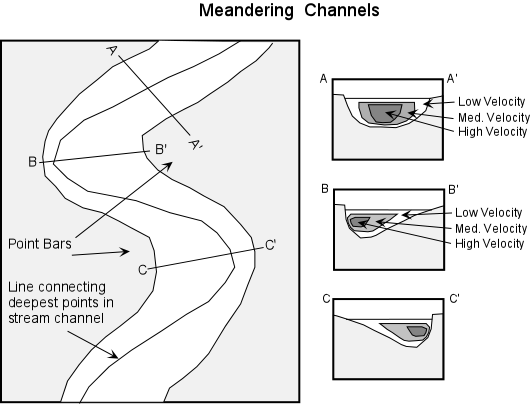
Water initially moves downslope in broad thin sheets. - it is dependent on both the water velocity and the types of particles being transported What are the consequences on particles with distance. A streams velocity depends on position in the stream channel irregularities in the stream channel caused by resistant rock and stream gradient.
B competence a stream s ability to move particles of a specific size. The ability to carry large particle sizes is dependent on the. - anytime sediment is in motion individual.
The ability to carry large particle sizes is dependent on the streams.
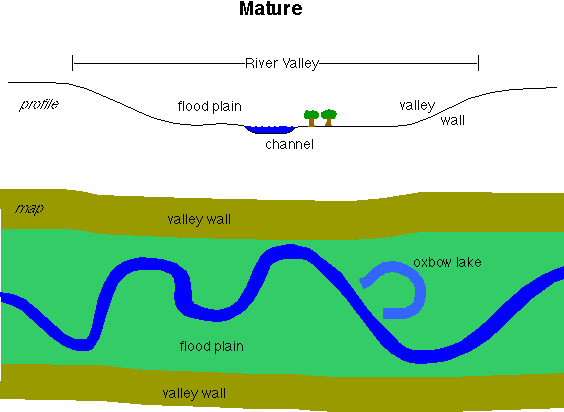
Stream Processes
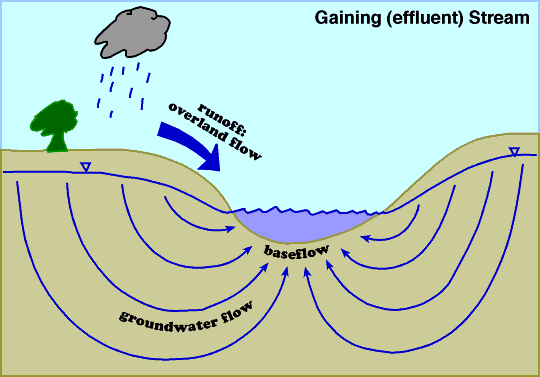
Stream Processes
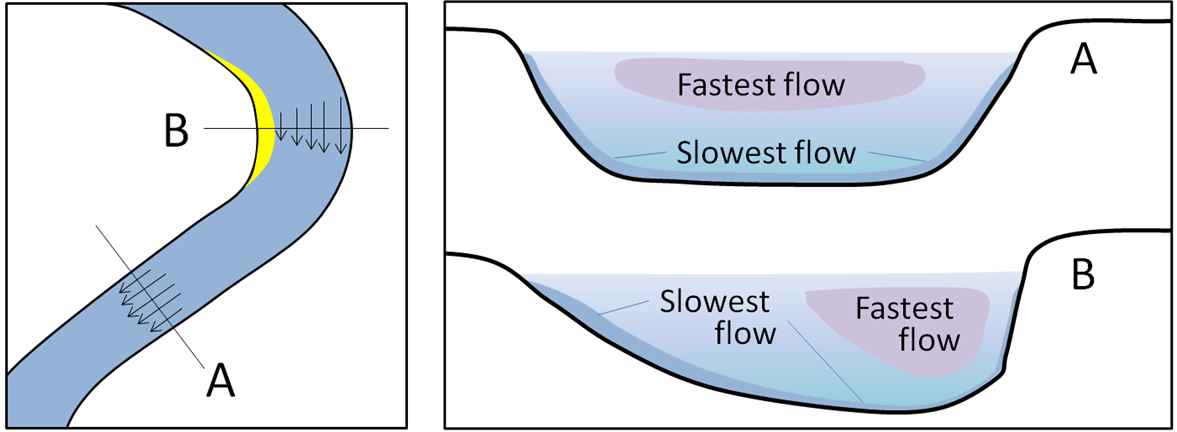
13 3 Stream Erosion And Deposition Physical Geology
Streams And Drainage Systems
No comments for "A Stream's Discharge Is Dependent on Which of the Following"
Post a Comment